







Issue 166 - December 2025
NEWS: WORTHY

End-of-Year Message
2025 has been a year of momentum and meaningful progress at the California JPIA. We’ve deepened our connections with you, our members, improved our technology platforms, and strengthened our staff to deliver better services. While navigating the changing landscape, we remain committed to our mission of providing innovative risk management solutions for our public agency partners.
We are especially grateful for the time and attention that members dedicate to implementing loss control programs and attending JPIA training events. When it comes to lowering risk and operating safely, Benjamin Franklin had the right idea when he wrote, “An ounce of prevention is worth a pound of cure.” The famous inventor, statesman, and founding father was likely not thinking of wood chipper safety when that was written. Although he did advocate for fire safety in the Pennsylvania Gazette in 1735. As it turns out, risk management is a timeless principle. When members actively pursue risk management strategies and partner closely with Authority staff, we all succeed together.
This year brought notable achievements as our regional risk managers responded to member needs with enthusiasm and creativity. New initiatives were developed and launched including: parade rules and guidelines (because public celebrations should be joyful, not litigious), funding for mental health resources, the Briefing Room partnership (law enforcement training), and funding for the wood chipper safety shield.
Our training team developed new content and rolled out an ergonomic self-assessment tool, law enforcement supervisory series, fire service supervisory series, and ‘Stop the Bleed’—a valuable complement to our CPR training that teaches individuals to recognize life-threatening bleeding and take immediate and effective action to control it. We are also proud to highlight recent additions to the Authority’s resource library, which include documents covering best practices for governance: Local Government Roles & Responsibilities, and Onboarding Newly Elected Officials.
Reflecting on past success is often followed by contemplation of what comes next. As we look ahead to 2026, here are some projects and goals on the near horizon:
- Web Content Accessibility Guidelines (WCAG)—Compliance Assistance
- New Evidence of Coverage (EOC) Portal—Simplified and Streamlined
- Land Movement Communications Toolkit
- Mental Health & Wellness Resources for Public Safety Personnel
- HR Professional Series—Hybrid Training Courses
Thank you for your partnership, engagement, and dedication to the communities that you serve. Many people depend on the municipal services that you help to provide. As public servants, your work is challenging, important, and can also be quite rewarding. It is our privilege to support you as you carry out your organizational mission. We look forward to working alongside you in 2026 and to the opportunities that lie ahead.
Wishing you a holiday season full of warmth and cheer.
Print Article
Supervisor Essential Skills Training Program Celebrates Successful Completion of Second Cohort
The California JPIA Supervisor Essential Skills Training Program Cohort wrapped in November, marking the end of the program’s second year. The program, which launched in 2024, has provided valuable training to new and seasoned managers.
“The Supervisor Essential Skills training was one of the best professional development experiences I’ve had in my entire career,” said Mark Iverson, superintendent of water operations in the utilities division of the City of San Clemente. “Sharonda and Renee were not only informative, but they taught from real-life experiences and practical skills that truly resonated. In my 25 years of experience, I have never taken more value away from a single training.”
The training provides supervisors with practical tools to meet the evolving challenges of public sector management. Developed for leaders at all levels, the program comprises nine interactive, one-day courses that focus on critical topics, including effective communication, conflict resolution, and diversity management.
“The program was created to address the challenges many supervisors face when stepping into leadership roles,” said Training Manager Ryan Thomas. “In its second year, the program continues to provide the soft skills managers need to succeed when supervising and managing employees. We are particularly excited about an online version of the series that will be available in early 2026 for the programs third year.”
Designed to equip current and future leaders with the essential tools for effective supervision, the program helped participants develop problem-solving techniques, enhance their communication skills, and refine their team management skills. Thomas continued, “The program provides a safe space for supervisors to ask questions, engage with peers from other agencies, and learn how to be better at their job.”
“Connecting with supervisors throughout the weeks and months of the program is inspiring. Seeing how they grow in terms of their thinking and how best to manage and influence their employees, creates a lot of peer-to-peer learning opportunities,” said Sharonda Bishop, one of the course program instructors. “Continuous learning is a journey, and finding ways to develop, grow, and enhance management skills play a crucial role in ensuring that our leaders are prepared for the evolving demands of their roles.”
As the program continues to develop, the Authority remains committed to supporting our members through educational opportunities that enhance leadership effectiveness, contributing to stronger teams and more efficient organizations.
Information about the 2026 cohort will be released in January 2026.
To learn more about the Supervisor Essential Skills Training Program, contact Administrative Analyst Denise Covell.
Print Article
Celebrating Excellence: California JPIA Affiliates Honored for Outstanding Service
The California JPIA is proud to celebrate two remarkable achievements that highlight the dedication, innovation, and leadership within our member agencies and partners.
Gene Ramirez Receives the Joe Rosen Lifetime Achievement Award
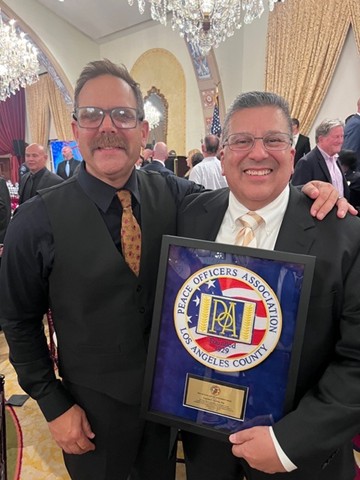
Congratulations goes to Gene P. Ramirez on receiving the prestigious Joe Rosen Lifetime Achievement Award from the Police Association of Los Angeles County (POALAC). This honor recognizes Ramirez’s decades-long commitment to law enforcement, public safety, and the advancement of professional policing standards.
As a founding member of Manning & Kass, Ellrod, Ramirez, Trester, Ramirez has built a career as one of California’s foremost legal experts in police liability, use of force, SWAT operations, canine programs, and training. His background includes service as a deputy district attorney for Los Angeles County, a reserve police officer, and extensive work advising public agencies on policies, procedures, and complex litigation.
Ramirez has long served as defense counsel to California JPIA member agencies, providing legal guidance and representation. His expertise has helped member police departments navigate critical challenges, reduce risk, and improve operational effectiveness. Beyond his legal practice, Ramirez is a respected educator and national presenter, training thousands of officers and supervisors across the United States and Canada. His lifetime of service has earned recognition from the U.S. Army Special Operations Command, the U.S. Secret Service, and multiple honors from the Los Angeles County Sheriff’s Department.
 Monrovia Police Department Honored for Excellence in Community Policing
The Authority also congratulates the City of Monrovia and the Monrovia Police Department for receiving the Centurion Award for Excellence in Community Policing-Team from the Police Officers Association of Los Angeles County. This recognition highlights the department’s innovative approach to serving the community through its Community Activists Policing (CAP) Bureau.
The CAP model—implemented in 1994—is built on the philosophy that reducing crime requires transforming the underlying conditions that allow it to grow. The program emphasizes cooperative, problem-solving relationships between law enforcement, public agencies, community partners, and residents. Monrovia’s CAP Bureau works closely with the San Gabriel Valley CARE team, an interdisciplinary group of mental health clinicians and substance abuse counselors, providing an alternative response to emergency situations.
Over the past five years, Monrovia has seen a significant increase in calls for service related to mental health crises, substance abuse, homelessness, and overdose deaths. Recognizing that law enforcement alone cannot fully meet these complex needs, the Monrovia Police Department has proactively expanded partnerships with service providers, nonprofit organizations, and community groups to deliver meaningful interventions and connect individuals to life-saving resources.
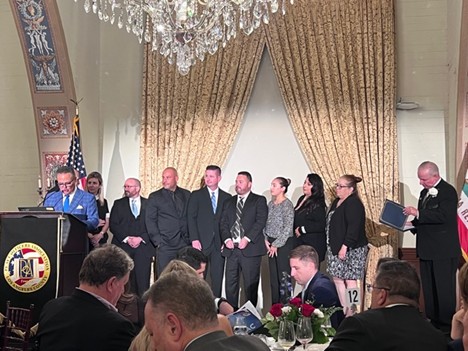
The CAP Bureau team, including Lieutenant Richard Schneider, Sergeant Damien Bartholomy, Community Policing Officer Thomas Montes, School Resource Officer Jazmin Holguin, Mental Health Clinician Lisa Gutierrez, and Substance Abuse Counselor Tara Jolola, exemplifies the spirit of community-centered policing.
This award represents a model for how local agencies can approach public safety with collaboration, care, and purpose.
Congratulations to Gene Ramirez, the City of Monrovia, and the Monrovia Police Department for these well-deserved honors. Their achievements reflect the values and mission of California JPIA—supporting excellence, safety, and service in our communities.
Print Article
The California JPIA Celebrates Longtime Liability Panel Attorney and Instructor Scott Grossberg
Scott Grossberg, who began consulting for the Authority in 1989, retired in November after 36 years of service to our members. Grossberg’s professional journey has been marked by a staunch commitment to public service.
After earning his undergraduate degree from California State Polytechnic University, Pomona, he received his Juris Doctor degree from the University of La Verne College of Law in 1986.
His work with the Authority naturally began from his early experience handling major litigation and training with the San Bernardino County Sheriff’s Department. Through his work with the Sheriff’s, he met a police chief from a California JPIA member agency.
“From that initial introduction, my work expanded across the membership. I found myself serving on the liability attorney panel, speaking, consulting, training, and being invited into increasingly complex matters,” said Grossberg. “Over time, my partnership with the Authority became one of the most meaningful and rewarding professional relationships of my life.”
“When I was the Authority’s liability program manager, having Scott on the defense panel was truly a blessing,” said Chief Operating Officer Paul Zeglovitch. “His ability to successfully manage complex litigation, but also all of the emotion and personalities involved, was masterful.”
Throughout his career, Grossberg has represented public entities, employees, and government pooling authorities in matters spanning civil rights violations, defamation, police liability, taxpayer lawsuits, and complex multi-jurisdictional challenges. His legal opinions and contract work have addressed the intricacies of cross-jurisdictional agreements and task forces, providing innovative solutions to some of the most challenging issues facing public agencies.
Over time, he has shaped the perspectives of public agencies on liability and risk management. “When I began, the emphasis was on winning cases—often through litigation strategies. As financial risks grew and jury unpredictability increased, the philosophy shifted. Members began to see settlement not as ‘giving in,’ but as another form of strategic victory,” he said. “Helping departments make that mindset shift required patience, guidance, and honest conversations. Observing agencies adopt strategic approaches to risk management has been one of the most gratifying aspects of my career.”
A passionate educator and communicator, he has led training for the Authority, the Department of the Navy, the Federal Bureau of Investigation, and numerous law enforcement agencies throughout California, sharing his expertise in media relations, emerging technology, stress management, police civil liability, mandated reporter training, motivation, and police civil liability.
Grossberg has taught tens of thousands of public sector professionals, and what he has enjoyed most has been watching them transform. “Whether it was teaching meditation and mindfulness to burned-out departments, introducing new leadership approaches to elected officials, or watching entire organizations shift after my ‘Creating Raving Fans’ seminars, the real joy was witnessing people reclaim confidence, perspective, and possibility,” he said. “Teaching has always been my way of giving back—of helping people see that they are capable of more than they realize.”
“Scott is so dynamic, multifaceted, skillful, and embodies all the great qualities of a ‘showman.’ He can read people and understand how to engage with them,” said Training Manager Ryan Thomas. “Whether as a trial lawyer or as a speaker/trainer, his ability to think on his feet, adapt to the audience, and take you on a journey is truly special. We’ve all heard the cliche ‘There will never be another…,’ but in this case it’s very likely true.”
Among his many professional achievements, he has served as lead trial counsel in four published appellate decisions affirming the rights of municipalities to set aesthetic standards for wireless facilities. The landmark 2009 case, Sprint PCS, Inc. v. City of Palos Verdes Estates, is widely cited throughout California. His appellate work includes notable cases involving the cities of Needles, Dana Point, and Bishop.
The California JPIA recognizes Scott’s distinguished career and his lasting influence on risk management, legal practice, and public service throughout California.
For those interested in learning more about Grossberg’s post-retirement career, visit his website.
Print ArticleRE: MEMBERS

City of La Palma Celebrates 70th Anniversary
The California JPIA recognizes the City of La Palma, which celebrates its 70th anniversary this year.
The city was incorporated on October 26, 1955, and holds a unique distinction among California JPIA members; it’s home to the Authority’s campus, located five minutes from La Palma City Hall.
“Having the Authority’s campus located in La Palma gives us direct access to staff, training, and resources,” said Deputy City Manager Joseph Cisneros. “The proximity allows our employees to participate in in-person workshops and programs without the added time and cost of travel. It also promotes a strong working relationship with frequent engagement.”
This close partnership extends beyond location. “The California JPIA is an essential partner in our risk management and organizational development efforts,” Cisneros added. “Their training programs, policy resources, and guidance on liability and workplace safety help us maintain consistent compliance and reduce operational risk. They also provide valuable support during claims handling and offer expertise that strengthens our internal procedures, staff readiness, and overall risk mitigation strategies.”
La Palma’s identity is built on maintaining its tight-knit community charm. “Our civic pride is rooted in small-town character, strong public safety, and high level of resident engagement,” said Cisneros. These values are on full display at La Palma’s annual events, like the Festival of Nations and Concerts in the Park.
La Palma has been an Authority member for 27 years, joining the California JPIA in 1998. The city has sustained its commitment to common values and community pride through seven decades of growth and change, and the Authority is honored to be a part of it.
Happy anniversary to the City of La Palma!
Print Article
Southeast Area Animal Control Authority Celebrates 50th Anniversary
The California JPIA recognizes Authority member the Southeast Area Animal Control Authority (SEAACA), which celebrated its 50th anniversary in October.
On October 16, 1975, the cities of Downey, Norwalk, and Pico Rivera co-established SEAACA to improve animal care and control services in the region. The organization has since grown to serve approximately 811,876 residents across 14 cities. SEAACA enforces animal-related laws, rescues animals from abuse and neglect, reunites lost pets with families, and adopts unclaimed animals to new homes while promoting responsible pet ownership.
“The California JPIA has been a continuous resource for our success,” said SEAACA Executive Director Denise Woodside. “The Authority creates our foundational resources and training. They have a deep understanding of risk management that our team makes efforts to follow. By regularly engaging with the Authority, we’re able to help animals and the community while doing everything we can to be safe and strategic.”
The partnership between SEAACA and the California JPIA extends beyond training. “They’ve been there for us when there are times of need, helping properly file claims and supporting us,” said Woodside. “Working in public service, these sorts of things do come up, so it’s important to have somebody there that you can rely on.”
SEAACA has received multiple recognitions from the California JPIA in acknowledgement of their efforts including risk management awards for best overall performance for non-municipal agencies for the liability and workers’ compensation programs.
“It is a pleasure working with Denise and her staff,” said Senior Risk Manager Melaina Francis. “SEAACA is deeply committed to continually improving their agency’s risk profile and maintaining a safe working environment for all employees. I look forward to our continued partnership in the years to come.”
The organization celebrated the milestone with proclamations, recognitions and commendation from member cities displayed in the front lobby, a staff luncheon, commemorative challenge coins for Board Commissioners and staff, and a $50 pet adoption promotion.
While celebrating 50 years of progress, Woodside noted there’s still work to do. “Currently, only about 30 percent of all pets acquired come from shelters. As much as we have enough to celebrate, there is always room for improvement!”
Congratulations to SEAACA for 50 years of protecting the health, safety, and welfare of both animals and people. To learn more about SEAACA or to adopt a pet, visit their website at SEAACA.org.
Print ArticleLEGAL MATTERS

New Legislation Makes Changes to California’s Transparency and Ethics Laws
By Thomas Jex, Partner; Joaquin Vazquez, Partner; Elena Q. Gerli, Partner; and Frances Agoncillo, Associate; Burke, Williams & Sorensen, LLP
A number of bills were signed into law this year that affect California’s primary transparency and ethics laws: The Brown Act, Political Reform Act and the Public Records Act. While some of these changes are minor, some bills, like Senate Bill (“SB”) 707 and 827, make sweeping changes to the way public agencies operate and how local agency officials and certain department heads and other administrative officials learn about transparency and ethical obligations. These new laws are summarized below.
SB 707 Provides Significant Changes to the Brown Act
SB 707, signed into law on October 3, 2025, proposes the most extensive modernization of the Brown Act (Gov. Code, § 54950 et seq.) in years, introducing sweeping changes designed to strengthen public participation and expand remote teleconferencing access. While aiming to improve transparency and engagement in public meetings, the bill also presents local agencies with important considerations regarding implementation logistics and resource planning. The bill primarily goes into effect on January 1, 2026, with some provisions going into effect on July 1, 2026.
Mandatory Brown Act Distribution
SB 707 amends section 54952.7 to mandate that a local agency must provide a copy of the Brown Act to any person who is elected or appointed to serve as a member of the legislative body of the agency. Previously, the distribution was permissive and limited to specified persons.
Teleconferencing as a Reasonable Accommodation
SB 707 adds a new subdivision (c) to section 54953 to expressly articulate that legislative body members may participate by teleconference as an accommodation for a disability. The member must participate using both audio and visual technology and must disclose if another adult is in the room with them, and the general nature of that person’s relationship with the member; the teleconferencing member’s participation counts towards a quorum at the same physical location as the members participating in person.
Expanded Teleconferencing Requirements
SB 707 expands and reorganizes the provisions relating to teleconferencing. The provisions for the “just cause” basis for remote legislative body meeting participation initially introduced in 2022 via AB 2449 are now set forth in section 54953.8.3. The bill extends the sunset for these “just cause” provisions through December 31, 2029, and the definition of “just cause” now includes certain prior bases for associated “emergency circumstances,” such as caregiving, illness, family medical emergencies, and military service. “Emergency circumstances” will now be included in the definition of “just cause.”
Remote Access and Multilingual Outreach Requirements
The bill adds a new section 54953.4, which imposes certain requirements on eligible legislative bodies from July 1, 2026 through December 31, 2029. Specifically, it requires eligible legislative bodies to offer public remote access to open meetings via telephonic or audiovisual platforms, and recess meetings for at least one hour to restore service if remote access fails. “Eligible legislative body” is defined in the bill to include city councils and county boards of cities/counties with populations of 30,000 or more, city councils in counties with 600,000 or more people, and certain large special districts—those with substantial populations, employees, or revenues. These eligible legislative bodies must translate meeting agendas and participation instructions into applicable languages (those spoken by at least 20 percent of the relevant population with limited English proficiency), provide a multilingual, accessible public webpage explaining comment procedures and meetings, and assist with interpretation requests.
Special Meetings Requirements
SB 707 modifies section 54956, regarding special meetings, to expand the 24-hour posting and distribution requirements to all legislative bodies by removing prior exemptions for certain legislative bodies. It also expands the prohibition on calling special meetings to consider local agency salaries or compensation for local agency executives to also include those for legislative bodies themselves.
Authority to Remove Disruptive Participants
The bill amends section 54957.95 to extend the authority of a presiding legislative body member to remove a person for disrupting a teleconferenced meeting.
The changes made by SB 707 are significant. Given the complexities of the changes, there is likely to be clean-up legislation next year to clarify some of the provisions.
Noteworthy Changes to the California Political Reform Act
The Governor signed a number of bills amending the Political Reform Act: SB 42, and 852 and Assembly Bills (“AB”) 953 and 1286. AB 1286 adds a financial interest (arrangement for prospective employment) that must be reported on the Form 700, AB 953 prohibits foreign nationals from contributing to elections, and SB 42 enacts the California Fair Elections Act of 2026, subject to voter approval.
SB 42.
The bill enacts the California Fair Elections Act of 2026, to be effective only if approved by the voters on November 3, 2026, and if so approved, lifts the prohibition against the expenditure of public funds for the purpose of seeking elective office and would allow such expenditures for citizen-funded election programs, in order to reduce reliance on wealthy donors and special interests, and to broaden election access.
SB 852.
Government Code section 84309 currently prohibits any person from receiving or personally delivering or attempting to deliver a contribution in the State Capitol, any state office building, or in any office for which the state pays the majority of the rent other than a legislative district office. SB 852 revises Government Code section 84309 to expand the prohibition to receiving or personally delivering or attempting to deliver a contribution in any local government office building and in any office space for which the local government pays rent, regardless of the proportion of government use in that building.
SB 852 also amends Government Code § 87500 to now require that officials who manage public investments, file their Statement of Economic Interest (Form 700) using the FPPC’s electronic filing system. This change does not alter which officials qualify as “public officials who manage public investments.”
SB 852 makes other changes relating to state-level processes.
AB 953.
Government Code section 85320 prohibits foreign government and foreign principals, as defined, from contributing to, or making expenditures in connection with, political campaigns. This bill amends that section to include that foreign nationals are also prohibited from contributions to or expenditures for political campaigns, and correspondingly prohibits a person or committee from soliciting such a contribution or expenditure from a foreign national.
AB 1286.
This bill provides that elected and appointed officials must disclose any “arrangement for prospective employment” on their Form 700. An “arrangement for prospective employment” means an agreement pursuant to which a prospective employer’s offer of employment has been accepted by the prospective employee.
Noteworthy Changes to the California Public Records Act
One noteworthy bill affecting the Public Records Act is Assembly Bill (“AB”) 370, which amends Section 7922.535 of the Government Code, also known as the California Public Records Act (“CPRA”), to expand the definition of “unusual circumstances.”
The CPRA requires each agency, within 10 days of a request for a copy of records, to determine whether the request seeks copies of disclosable public records in possession of the agency and to promptly notify the requester of the determination. The CPRA further authorizes an extension of no more than 14 days for “unusual circumstances” which include, among other things, the need to search for, collect, and appropriately examine records during a state of emergency when the state of emergency currently affects the agency’s ability to timely respond to requests due to staffing shortages or closure of facilities.
AB 370 expands the definition of “unusual circumstances” to include an agency’s inability to access its electronic servers or systems to search for and obtain a record that the agency believes is responsive to a request and is maintained on the servers or systems in an electronic format, due to a cyberattack. The extension would apply only until the agency regains its ability to access its electronic servers of systems and search for and obtain electronic records that may be responsive to a CPRA request—in which case, the extension could be less than 14 days.
Public agencies must still comply with the 10-day deadline if the requested records are maintained in a location other than on the electronic server or system affected by the cyberattack, or if the records are maintained in a nonelectronic format.
Changes to Ethics Training Requirements
SB 827 updates and expands California’s mandatory ethics training framework (Government Code § 53234 et seq., also referred to as “AB 1234”), for local agency officials, including cities (including charter cities), counties, charter counties, school districts, county offices of education, charter schools, and special districts. Under existing law any member of a local agency legislative body or elected official receiving any compensation, salary, stipend, or expense reimbursement—along with designated employees—must complete two hours of ethics training every two years. SB 827 expands who must receive ethics training, ensuring that department heads and similar administrative officers of all types of local agencies are included within the AB 1234 framework.
SB 827 also mandates a new, standalone fiscal and financial training mandate for a broad range of local agency officials, including legislative body members. Officials that are in service before January 1, 2026, must complete the fiscal training by January 1, 2028, and officials who begin service on or after January 1, 2026, must complete training within six months from the first day of service. Thereafter, the fiscal and financial training must occur every two years.
SB 827 establishes requirements that local agencies provide information about available fiscal and financial training at least once annually to local agency officials and that records relating to ethics and fiscal training be retained for five years. By July 1, 2026, local agency websites must include posted instructions and contact information for requesting these records.
Print Article
Hakimi v. City of Los Angeles: Lessons on Complaint Handling and Hazard Response
In September 2025, a Los Angeles jury awarded $48.8 million to the family of Daniel Hakimi after he suffered a catastrophic brain injury when his bicycle struck a large pothole. The evidence showed that residents had submitted complaints about the roadway defect for nearly two years before the incident. Despite repeated warnings, the hazard remained unrepaired.
Under California Government Code Section 835, public entities are liable for injuries caused by dangerous conditions of public property when they have actual or constructive notice of the condition and sufficient time to take protective measures. In Hakimi, the jurors concluded that the City had clear notice and an opportunity to rectify the hazard but failed to do so.
The outcome illustrates a growing trend of “nuclear verdicts” driven not only by the severity of injury, but also by juror anger at government inaction. The lesson for public agencies is clear: complaints should not be disregarded, even if they come from the same residents repeatedly.
Connection to Whitehead v. Oakland
Earlier this year, in Whitehead v. Oakland, the California Supreme Court reaffirmed that public agencies have a non-delegable duty to maintain property in a non-dangerous condition, even when waivers are used. The Hakimi verdict illustrates the practical consequences of the same principle: when agencies fail to mitigate hazards despite repeated warnings, juries will severely punish them.
Together, Whitehead and Hakimi deliver a consistent message: risk transfer tools, such as waivers and indemnification language, are important, but they cannot replace diligent inspection, complaint handling, and timely maintenance.
What This Means for Public Agency Risk Management Strategy
The Hakimi decision underscores the importance of proactive systems for receiving, routing, and resolving hazard complaints. An inspection program alone is not enough—agencies must also demonstrate that they act on reports from the public.
Centralized Complaint Intake
- Establish a standard procedure to capture date, source, location, and hazard details.
- Route complaints, regardless of who receives them, to the department responsible.
- Why this matters: Helps ensure no complaint is “lost” or dismissed as routine.
Routing and Documentation
- Record which department or staff member received the complaint and when it was forwarded.
- Maintain a log of interim measures (cones, signage, temporary patching) and repair dates.
- Why this matters: Jurors expect agencies to show diligence even if permanent repair takes time.
Managing Repeat Complainants
- Consolidate duplicate complaints into a single open case.
- Acknowledge each report and link it to the same file with notes on status.
- Why this matters: Demonstrates responsiveness without overwhelming staff and prevents a narrative that the agency “ignored” persistent residents.
Staff Training and Culture of Reporting
- Train all employees, clerks, recreation staff, public safety dispatch, and maintenance crews, so that hazard complaints are documented and forwarded appropriately.
- Provide simple written instructions with the intake procedure.
- Why this matters: Jurors punish agencies when complaints “fall through the cracks.” Training creates consistency and defensibility.
Moving Forward
The Hakimi verdict illustrates how quickly unresolved complaints can escalate into catastrophic liability. Agencies are encouraged to:
- Review complaint intake and routing procedures.
- Adopt a standardized procedure for all staff.
- Train employees on how to document and forward complaints.
- Develop prioritization standards for hazard response.
- Maintain a defensible record of interim and permanent actions.
The California JPIA has released the Complaint & Hazard Reporting Guidelines and Best Practices in the online resource library. The document provides recommended best practices and an example intake tool that members may adapt to support their existing complaint handling and hazard response processes. The guidance is intended to help members recognize, document, and route complaints so that reported issues can be evaluated and addressed through the appropriate internal processes.
For questions or additional information, please contact your regional risk manager.
Print Article
SB 827: Local Agency Officials: Training
Authored by Lena Gonzalez; co-authored by Jesse Arreguín, and Rhodesia Ransom
Chaptered on October 11, 2025, for CalMatters.
Existing law imposes ethics training on specified local agency officials. Existing law requires each training to be 2 hours and requires the officials to receive each training every 2 years, and as described otherwise, with the first training within one year of commencing service. Existing law requires the local agency to maintain records of the trainings, as prescribed.
This bill would expand which local agency officials are required to complete the above-described ethics training to include department heads, or other similar administrative officers, as specified, and would instead require officials who commence service on or after January 1, 2026, to receive their initial training within 6 months of commencing service. The bill would require the local agency to post clear instructions and contact information for requesting the training records on its internet website, as specified.
This bill would additionally require all local agency officials, as defined, to receive at least 2 hours of fiscal and financial training, as described. The bill would require the training to be received at least once every 2 years, as provided. The bill would exempt from these requirements specified local agency officials if they are in compliance with existing education requirements specific to their positions.
This bill would authorize a local agency or an association of local agencies to contract with or otherwise collaborate with a provider of a training course to offer one or more training courses, or sets of self-study materials with tests, to its local agency officials to meet the training requirement, as described. The bill would require the training courses and materials to be developed in consultation with experts in local government finance, as specified. The bill would require providers of training courses to provide participants with proof of participation for purposes of complying with specified recordkeeping requirements. The bill would require a local agency to provide information on training available at least once annually. By imposing additional duties on local officials, the bill would create a state-mandated local program.
The bill would include findings that changes proposed by this bill address a matter of statewide concern rather than a municipal affair and, therefore, apply to all cities, including charter cities.
The California Constitution requires the state to reimburse local agencies and school districts for certain costs mandated by the state. Statutory provisions establish procedures for making that reimbursement.
This bill would provide that, if the Commission on State Mandates determines that the bill contains costs mandated by the state, reimbursement for those costs shall be made pursuant to the statutory provisions noted above.
______________________
Per California state law known as AB1234 and SB 827, the Authority offers online “Ethics for Local Agency Officials” training for elected and appointed local officials, as well as department heads and senior staff who make financial decisions. The Authority does not offer the financial training mentioned in this article, but we are monitoring developments to provide members guidance regarding potential providers as it becomes available.
Print Article