

Issue 170 - April 2026
RE: MEMBERS
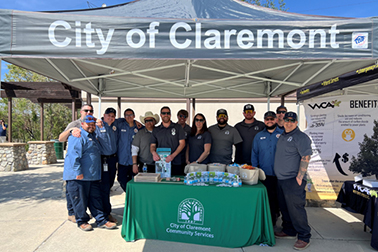
Celebrating Public Works Appreciation Week with the City of Claremont
“Claremont’s Community Services Department plays a foundational role in keeping our city safe, accessible, and livable on a daily basis,” said Deputy City Manager Katie Wand. “Their work includes maintaining our parks, public spaces, streetscapes, and urban forest; providing sanitation services; and ensuring our infrastructure—like roads and sidewalks—is functioning properly. These efforts help prevent hazards, improve visibility and walkability, and create spaces where residents feel safe and welcome.”
During the past year, the community services department has partnered closely with the California JPIA to proactively identify hazards, improve safety, and invest in long‑term solutions that benefit the entire community. The department’s proactive and practical mindset defines its approach to risk management.
“Instead of waiting to react to incidents, Claremont consistently looks ahead—identifying potential hazards early and tackling them with thoughtful, sustainable solutions,” said California JPIA Senior Risk Manager Tony Leite. “Whether they’re assessing sidewalks throughout the community, investing in employee safety equipment, or mitigating unique site-specific risks, Claremont integrates risk management into both its daily operations and long-term planning.”
Improving Sidewalk Safety and Accessibility
In June 2025, the city utilized the Authority’s Precision Concrete Master Services Agreement to conduct a comprehensive sidewalk assessment. This effort helped identify sidewalk hazards across the community and prioritize repairs to reduce trip hazards, improve accessibility, and enhance pedestrian safety for residents of all ages and abilities.
“The assessment provided the city with a comprehensive understanding of current sidewalk conditions, which staff will use to develop the upcoming sidewalk rehabilitation program,” Wand said. “This effort was important because it enabled the city to take a data-driven approach in allocating resources efficiently and addressing the most critical repair needs.”
Investing in Employee Safety
The city also strengthened employee safety by installing a wood chipper safety system on public works equipment. This system—funded through the Authority—enhances operator protection and reduces the risk of serious injuries during routine maintenance and tree work.
“Enhancing safety features helps reduce the risk of accidents by providing built-in protections that do not rely solely on operator experience or memory,” said Wand. These improvements help ensure that even infrequent use is conducted as safely as possible, ultimately protecting employees and reducing potential liability.”
Proactive Yard Safety Improvements
Through participation in a Risk Management Evaluation Safety Assessment, the city identified potential hazards within the public works yard and implemented corrective actions to improve overall safety. When a fall protection concern was identified, the city used the Authority’s Risk Technician Program to evaluate the work activity and implement an engineering control to guard against the fall hazard, reducing risk while allowing work to continue efficiently and safely.
“The Risk Management Evaluation brought tremendous value to our operations by providing a structured, comprehensive assessment of our risk profile across departments,” Wand said. “Through the LossCAP program, the evaluation helped us move beyond a reactive approach and instead take a more proactive, data-informed approach to risk management.”
The evaluation also strengthened internal coordination, providing a roadmap for departments to align on and reinforcing a culture of shared responsibility for local safety.
Smart Risk Management in Community Projects
The Community Services Department used the Contractual Risk Transfer Manual and worked with Leite to support the donation of playground equipment during a recent playground replacement project. This ensured the transfer was handled responsibly, protecting both the city and community partners while keeping playground improvements moving forward.
“Claremont demonstrates how to creatively mitigate risk without defaulting to removal or restriction,” Leite said. “The city’s approach is a great example of how to balance safety, employee protection, and community service, while still moving projects forward efficiently and responsibly.”
A Commitment to Safety, Stewardship, and Service
For Claremont, protecting public safety doesn’t mean sacrificing community character.
“In Claremont, our defining character—walkable neighborhoods, mature trees, and active public spaces—is also part of what makes our city feel safe and welcoming,” Wand said. “Rather than viewing these priorities as competing, we work to reinforce both.”
These efforts reflect the dedication, expertise, and forward‑thinking approach of Claremont’s Community Services Department. By identifying risks early, leveraging available resources, and investing in practical solutions, they continue to enhance safety, protect public assets, and deliver high‑quality services to the community.
< Back to Full Issue Print Article