

Issue 172–June 2026
RE: MEMBERS
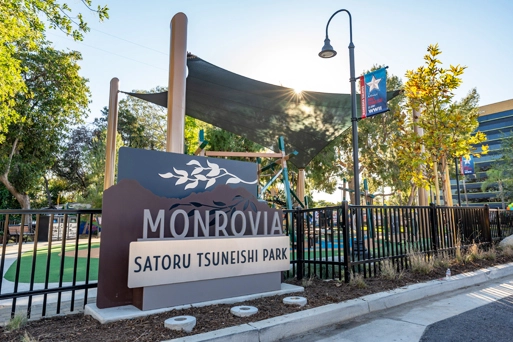
City of Monrovia Celebrates Park and Recreation Month with Satoru Tsuneishi Park
The project originated from the citywide parks master plan adopted in 2018, which identified a need for park space south of Huntington Drive and the 210 freeway. Because Monrovia is the fourth-oldest city in Los Angeles County and is nearly built out, finding open space presented a significant challenge. However, in 2021, a local company donated an open tract to the city, providing the park space.
Community Services Director Rebecca Sandoval emphasized that the city does not plan parks in a vacuum. Starting in the fall of 2023, the department conducted extensive outreach, connecting with residents, local businesses, and managers from a neighboring hotel. This collaborative approach revealed operational and risk management considerations that directly shaped the park design.
“We heard from a local hotel that many of their guests are receiving treatment at the City of Hope hospital and are looking for a space to read, so we knew benches were going to be important,” said Sandoval. “We heard from nearby restaurants that there is a lot of trash getting left in their driveways. From the community, we heard that coyotes frequented the neighborhood because there was a wash nearby.”
To address these concerns, the city selected specialized, compacting trash receptacles rather than standard bins to mitigate wildlife interactions. Due to the proximity of Route 66 and the 210 Freeway, traffic safety was another primary focus. The city coordinated with its traffic safety committee to evaluate vehicle flows, ultimately installing a perimeter fence with push bar gates around the playground. To encourage safe pedestrian habits, the city partnered with an adjacent restaurant to paint pathways leading safely to the park entrance. The department also installed energy-efficient safety lighting to deter unauthorized nighttime use and to support hotel guests utilizing the walking paths. The playground features pour-in-place surfacing, Americans with Disabilities Act-compliant parking spaces and ramps, and diverse play options that accommodate children of all abilities.
“By incorporating risk management throughout every phase of the project, city staff helped deliver a park that prioritizes safety, durability, and community value,” said California JPIA Senior Risk Manager Maria Galvan.
Staff also worked to tie the park to Monrovia’s local history. Following the city’s public naming policy, residents selected the name to honor Satoru Tsuneishi, an acclaimed haiku poet and the first Japanese American graduate of Monrovia-Arcadia-Duarte High School, whose family farmed strawberries along Route 66. The city incorporated historic touches throughout the space, including an art mural depicting his life story and wraps with historical photographs of local Asian American families.
The City of Monrovia continues to prioritize playground safety and improvements, with upcoming projects planned for Kiwanis Park and Recreation Park. For other member agencies balancing community programming with risk management, Sandoval advises looking beyond municipal borders. A project is more successful when the community is involved as partners, including local historic groups, traffic committees, businesses, and the California JPIA.
“The project is just so much more seamless when the community is involved,” said Sandoval. “It is not in a bubble. So many hands helped make the park even better, which is so rewarding.”
< Back to Full Issue Print Article