

Issue 174 - August 2026
NEWS: WORTHY
Celebrating National Service Dog Month
Service animals are defined as dogs that are individually trained to do work or perform tasks for people with disabilities. Under the ADA, dogs whose sole function is to provide comfort or emotional support do not qualify as service animals. The work or task a service dog has been trained to provide must be directly related to the person’s disability. Some examples of these tasks include guiding individuals who are blind, alerting individuals who are hard of hearing, pulling a wheelchair, picking up items such as medication, assisting during a seizure, and providing support for balance.
In addition to service dogs, the Department of Justice (DOJ) has a separate provision regarding miniature horses. As with their canine equivalents, miniature horses must be individually trained to perform a specific task for a person with a disability. As a service animal, a miniature horse has the right to accompany their handler in public places covered by the ADA. Miniature horses are less common than service dogs, but they can be a legitimate service animal.
Generally, Title II (State and Local Governments) and Title III (Public Accommodations) entities must permit service animals to accompany people with disabilities in all areas open to the public. Exceptions include situations in which the service animal poses a direct and immediate threat to others or would fundamentally alter the nature of a service or program. In such cases, service animals may be prohibited. A service animal must also be under the control of its handler. Under the ADA, service animals must be harnessed, leashed, or tethered, unless the individual’s disability prevents the use of these devices or they interfere with the service animal’s safe, effective performance of tasks. In these cases, the individual must maintain control of the animal through voice, signal, or other effective controls.
When it is not readily apparent what service an animal provides, only limited inquiries are allowed. Staff may ask two questions: (1) Is the dog a service animal required because of a disability, and (2) what work or task has the dog been trained to perform. Staff cannot ask about the person’s disability; require medical documentation, a special identification card, or training documentation for the dog; or ask that the dog demonstrate its ability to perform the work or task.
It is important to provide staff training on the ADA’s service animal requirements to prevent potential grievances. Service animal handlers are not required to show a certificate or identification, have a vest on their animal, or prove their animal is a service animal. A service animal may not be excluded based on assumptions or stereotypes about the animal’s breed, how the animal might behave, or their size. Staff should also understand that there are invisible disabilities. Your agency’s staff are not required to provide care for or supervise a service animal: It is always the handler’s responsibility. There is no limit on the number of service animals a person can use; however, the number must be reasonable, and the handler must explain what each animal does. A covered entity cannot charge a deposit, surcharge, cleaning fee, or other fee to a person with a disability as a condition of allowing the person to use their service animal. However, if a service animal causes damage, the handler must pay for repairs. The California Disabled Persons Act allows disabled persons to bring service animals in training to public places. Service animals in training must be on a leash and wear a county-issued tag identifying them as service animals.
There are instances where a service animal may need to be excluded. A handler may be asked to remove a service animal from the premises if the animal is out of control (e.g., running around, growling, barking) and the handler does not take effective action to control it, or if the animal is not housebroken. However, accidents may happen. If the handler can, they should clean up after their animal. Service animals can also be excluded if their behavior poses a direct threat to the health or safety of others. If it is determined that a service animal will be excluded, staff should remain calm, respectful, and professional when asking the handler to remove the animal and explain why it must be removed. The handler may return without the animal. While not required under the ADA, implementing a service animal policy is recommended. Written policies are typically required under a DOJ settlement agreement.
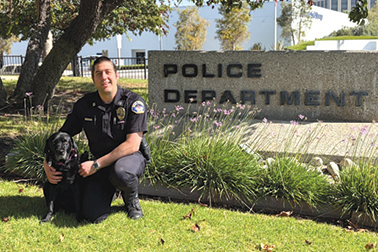
Member Spotlight: Police Facility Dog Yosa
While not a service dog as defined under the ADA, Seal Beach Police Department Facility Dog Yosa serves an important role in supporting both the community and department personnel. Yosa is an eight-year-old Labrador professionally trained and provided by Canine Companions, an organization accredited by Assistance Dogs International (ADI), which establishes internationally recognized standards for assistance-dog training, placement, and care. She is used to help facilitate interviews with children, make death notifications, and bring comfort to those exposed to trauma. Facility dogs like Yosa receive extensive professional training to work alongside a trained handler in a specific professional setting. Yosa knows approximately 50 commands and can assist during interactions with victims and witnesses, at community events, in employee wellness efforts, and during critical incidents.
A facility dog is different from an emotional support or therapy dog. Emotional support animals primarily provide comfort through their presence, while therapy dogs typically participate alongside their handlers in visits or activities designed to comfort others.
That distinction is important because the value of a facility dog comes not only from the dog’s temperament, but from the combination of professional training, a trained handler, and a clearly defined purpose. ADI-accredited programs follow rigorous standards related to dog selection, training, placement, handler education, and ongoing support. For a police agency, that structure helps ensure the dog is prepared to work safely and predictably in environments that may be unfamiliar, crowded, emotional, or stressful. That professional foundation matters in practice.
Yosa’s role is intentionally broad, but it is not casual. She may sit quietly beside a child during an interview, remain with a family during a difficult notification, attend a community event, or spend time with employees following a traumatic incident. In each setting, the goal is to reduce stress, encourage communication, and create a calmer environment. She is also available as part of the department’s wellness efforts, giving employees a low-pressure way to decompress after difficult calls or demanding shifts. “Yosa has a unique ability to change the tone of a room,” Captain Nick Nicholas said. “She helps us connect with people during difficult moments and provides valuable support to our own personnel.”
Nicholas noted that agencies considering a facility dog should think carefully about how the dog will be incorporated into daily operations. A successful program requires more than selecting the right dog. The handler must be available to maintain the dog’s training, respond when the dog can be useful, manage the dog’s health and care, and make thoughtful decisions about when deployment is appropriate. The organization must understand that the dog is a working resource with a specific mission, not simply a mascot or office pet. There are also practical considerations. Agencies should establish clear policies addressing the dog’s role, supervision, deployment, care, transportation, training, and use during critical incidents. They should also educate employees about what the dog is and what it is not, and how the program supports existing victim services, community engagement, and employee wellness efforts.
Another important consideration is continuity. A facility dog becomes most effective when employees understand when to request the team, and the handler is integrated into the agency’s response practices. Success also depends on understanding the dog’s capabilities and allowing the handler to decide whether a particular environment or assignment is appropriate at that time.
For agencies considering a facility dog, Nicholas recommends working with an ADI-accredited organization. “The right training, handler, organizational support, and clearly defined mission are what make the program successful,” said Nicholas. Members considering obtaining a facility dog are encouraged to contact Nicholas, who has guided several agencies through the comprehensive process of obtaining their department’s facility dog.
For more information, visit:
ADA Requirements: Service Animals
Frequently Asked Questions about Service Animals and the ADA
Canine Companions–Facility Dogs
If you have questions, please contact your regional risk manager.
< Back to Full Issue Print Article